
No. 1 - The Apple: On Desire, Discernment and Crimes Against Wisdom
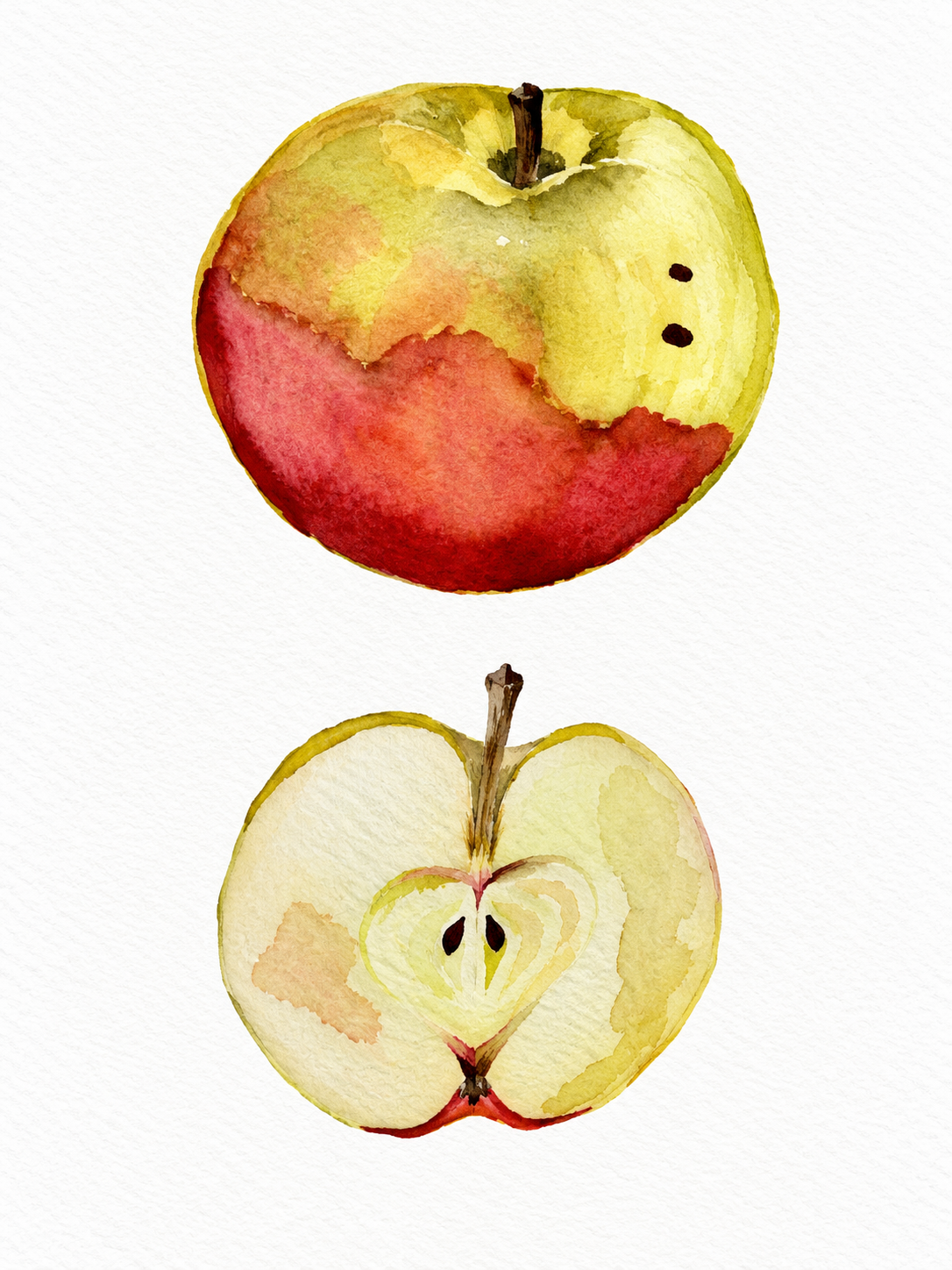
Watercolor by Jacqueline Foster
I grew up in “Apple Country,” the rich upland hills and river valleys of central Massachusetts, where orchards were so ubiquitous, I imagine my relationship to apples is like that of a native Californian to citrus fruit—so familiar that I forget how incredible it is that this beautiful fruit grows in my backyard.
The haunting habit of their knotty branches and the familiar smell of fallen fruit—what the tree could not hold—fermenting into the soft ground beneath inhabit the landscape of my childhood memories. Their low-hanging limbs and ruddy bark offer easy purchase to young New England climbers, many of whom first learn the thrill of ascent in the sturdy branches of an apple tree. Come harvest season, entire outings are dedicated to the fruit—climbing rickety ladders to pick the best ones while sipping spiced hot cider and noshing on (usually way too many) cider donuts. A bottle of apple juice had a permanent home in our refrigerator, its label so familiar that, to my parents’ delight, I skipped right over the usual two- and three-letter words and spelled aloud: A-P-P-L-E.
The town next door was the birthplace of Johnny Appleseed, who was not merely a fictional character of children’s storybooks, but John Chapman: an O.G. foodie, nurseryman and religious eccentric (on brand for his time) who dedicated much of his life to propagating apples across the expanding American frontier. The Johnny Appleseed I remember from school, my inherited apple mythology, was a barefoot wanderer, spreading seeds not unlike the Lupine Lady (another beloved New England character). But Chapman was far more methodical in his approach. He did plant an enormous number of seeds, but rather than scattering them indiscriminately, he established nurseries, fenced them against animals and sold the seedlings as they grew. His prolific planting was driven partly by commerce; the vast distances he traveled, partly by evangelism. Somewhere between the historical man and the storybook character, the method was lost and the abundance remained: a man walking west, leaving apple trees in his wake. The reality was more deliberate and, botanically speaking, much stranger.
